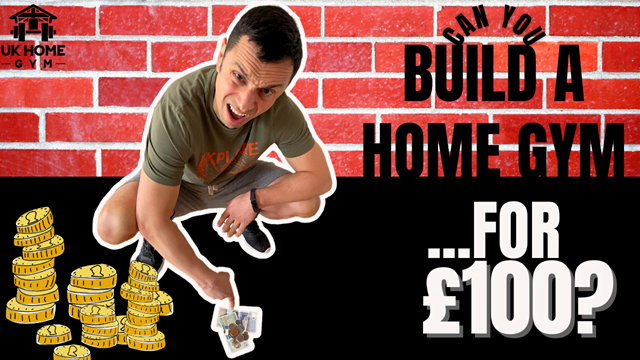
The most off-putting thing about creating a home gym in the UK is undoubtedly the upfront cost. Just take a quick look at equipment online now and you’ll see some pretty prohibitive prices.
Since the pandemic, prices have gone up quite dramatically – and inflation has sent them up even further.
The thing is, gym memberships aren’t getting any cheaper either. In my area, prices vary from £22 a month for a basic, big box chain gym in a less salubrious part of town to £70 for a slightly more upscale alternative. But these prices go up every year.
So right there you have one pretty big argument for starting your own home gym. If you bought all your equipment today, you wouldn’t have to worry about future price rises.
Ah, you may say. But my local gym is stuffed to the gills with all sorts of lovely machines, neatly stacked dumbbell sets and shiny barbells.

Just how exactly am I supposed to afford that lot? Can you really build a home gym for 100 little pounds?
Sure, you cannot hope to recreate the same commercial gym experience at home – and certainly not for a mere £100.
But you might be surprised to learn that £100 can actually get you a long way. And for the price of less than two months of posh(-ish) gym fees, you can buy some fairly decent equipment that could – in theory – last you a lifetime.
Bearing in mind that I’m saying this in early 2024, so this advice may well age like milk. But at the time of writing, these four items will cost you £100 or less. And they will let you create your own basic, no-frills – but highly effective – home gym!

Build a Home Gym for 100 Quid: Your Shopping List
Item #1: Power Tower Pullup & Dip Station
I bought my own… ahem…SogesPower Dip Station SP-PSBB002 for about £87 back in late 2020, which is strangely out of stock in the UK as I write this, but is available in Walmart in the US.
Whatever. These are generic pieces, and their prices don’t appear to have gone up too much since 2020. I think that is mainly because about a million companies making this kind of gear.
They are super-lightweight, probably don’t take up much volume in a shipping container and aren’t made from very durable material. The paint coating isn’t very special either.
You can often find the stations these are based on in commercial gyms. But those things cost upwards of £1,000. So for under £100, you can’t expect to find anything of that sort of quality – or durability.
But guess what? You don’t really need it.
OK, the £1,000 version feels like you could swing a family of buffaloes from it and it wouldn’t budge an inch. The sub-£100 knockoff feels like you might be able to knock it over with a multipack of Quavers.

But while you can’t swing off the cheap versions, you can pull and push vertically on them. And – really – what else do you want from a pullup bar that also doubles as a dip station? I’ve had mine since 2020, as I said, and it’s gone from a corner of my living room to the garage – and I still use it almost every day.
And that’s despite having several other – much better and more expensive – pullup bars.
I’ve seen new towers on eBay and Amazon for £60-70. This model often goes on sale for around £55 on Amazon.
And – unlike other gym equipment in the UK – people tend to sell these things for reasonable prices (I saw a few for around £20 on eBay, Gum Tree and Facebook Marketplace while writing this post).
I’d personally buy new with equipment like this, because who knows what previous wear and tear it’s been through. But you do you.
Item #2: Sandbag
It’s a toss-up between sandbags and kettlebells for the title of ultimate Strength + Conditioning tool. But I’d pick sandbags any day of the week if I was forced to choose.
The idea is simple: Buy a sturdy bag. Fill it with sand. Lift it up and chuck it around your garden. Get fit.
In reality, things are slightly more complicated than that. You need a sturdy bag – ideally one that has been designed for the task, and one that can fit in the kind of weight you are hoping to use.
I recommend buying an actual exercise-specific sandbag, as they tend to be the toughest cookies on the market. Many of them have additional handles that let you grab the bag from all sorts of different angles.
And, despite the name, I don’t recommend filling these things with actual sand – it’s far too messy a process. Gravel is a better bet, and I also recommend filling up any empty space in the bag with newspaper, bubble wrap, rags or old clothes and a pool noodle if possible.
You want that perfect combination of shapelessness and firmness for the ideal sandbag experience!

You can buy a nice, attractive, branded bag for £40, but you can go lower end for this item. A generic bag itself shouldn’t cost you any more than £15-17 for a lower-end model that will take around 15-20kg.
I’d steer clear of second-hand sandbags. People tend to slam these things around on concrete floors quite unceremoniously, so beware!
A pool noodle (not essential, but very helpful) should cost you about £5 or maybe less. But you may be able to pick one of these up for peanuts second-hand – and you don’t need it to be in any kind of condition!
Amazon suggests I buy this in pink – oh, Amazon, you know me too well!
Item #3: (Fabric) Booty Band
This one is bound to be met with a sharp intake of breath from gym bros. But hear me out. You won’t have much left from £100 if you have invested in the two items above, so you don’t have much money to play with here.
But most of us – even the most hardcore of gym rats – completely neglect to train our glute medius muscles. Working your glute medius won’t make you look jacked. It won’t allow you to squat 200kg. However, these important muscles abduct the hips, and assist in flexion and medial rotation.
In most of us, they are underdeveloped. If that’s so, they can become weak in comparison with other leg muscles, causing all sorts of problems.
And in my case, I’ve certainly noticed that can lead to other muscle issues throughout the body.

It takes no time at all to work these muscles. Just three sets of clamshells three times a week should be enough. And a booty band provides you with pretty much all the resistance you need to keep them strong enough to not cause you problems.
When you get really strong, you can double up the bands. But in most cases, that won’t be necessary.
After learning the hard way that the super-cheap plasticky rubber things are a load of rubbish that snap if you stare at them hard enough, I recommend the fabric versions. They are a lot more durable, comfortable and less likely to slip.
Item #4: Ab Wheel
With whatever money you have left, get on Amazon, eBay or whatever and buy yourself one of these.
Crunches are all well and good, but ab wheels let you stretch your lats out while training your core, which is a very good thing – or so I’m told. You can use them to train your obliques and your transverse abdominis, and they help you learn about moving your lower back in sync with your abdominal muscles.

I have one of the cheapest models available, which is totally fine – it set me back about £4-5. It also came with a little yoga mat-like knee mat thing that I now use to rest kettlebells on. But for slightly more money you can get a version with a wheel that looks like it belongs on a vehicle of some sort. These are a lot smoother and feel more steady under your hands.
And That’s Your Lot
You see? It is very possible to build a home gym for 100 quid. And you can now say you have a home gym – of sorts. You can use it to do pullups, dips, overhead lifting, weighted conditioning, core-focused workouts…and those all-important clams!

What do you think of my picks? Can you think of any better ways to spend £100 on home gym gear? Please share your thoughts!


