

Google searches for the term “home gym UK” shot up during the COVID pandemic and the lockdowns. And they’ve stayed high ever since.
That’s no surprise for most of us. Living in the UK is increasingly expensive, with our seemingly endless cost of living crisis. And that is why, even as the price of equipment continues to creep up, investing in a home gym has now become – I will argue – essential for almost all Brits.
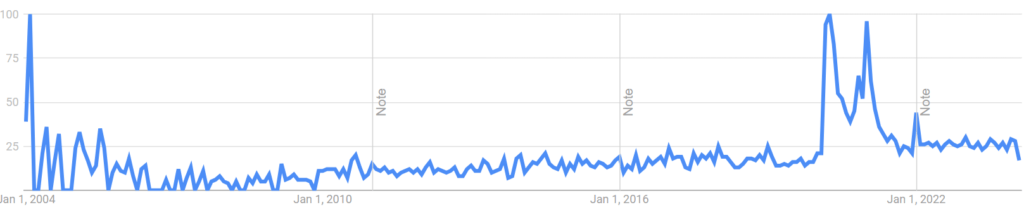
Image: Google Trends
“Almost” above is key. There are two big exceptions, which I will get onto shortly. But if you don’t fall into these exceptional categories, failing to buy a home gym is likely to become something you regret more and more with each passing month.
Here’s why.
Home Gym UK Needs Are High, and This Is Why
There are three big reasons why a home gym is so important to Brits today. I won’t go into too much detail on the first, but I will give a brief overview. The second two really matter – and could convince you to start taking steps today.
Longevity
British people are becoming increasingly unfit, overweight and sedentary, and issues like chronic back pain, depression, heart issues and the rest are all on the rise. Resistance training has been proven, time and again, to help counter all these in both younger and older populations.
Having workout equipment in your home reduces the friction involved with going to a gym. Some people feel self-conscious about lifting in public.
A home gym helps with that too. And if you have made the investment (time, space and money) involved in creating a home gym, it is forever there in your house, guilt-tripping you into actually using it.
Finance
At the time of writing, gym memberships in my area – and I will be generous and extend that to a 15-mile radius – cost between £22 and £60 a month.

On the higher end, you have upscale gyms that want to maintain a veneer of exclusivity. They do this by purposely cranking up their fees and setting up shop in high-rent areas to cater to a wealthy clientele.
On the lower end, you have 24-hour chain gyms that will only let you use their facilities during “off-peak hours.”
For most gyms, “off-peak” means any time up to 4 pm on weekdays, and then from about 9 pm onwards. I cannot begin to tell you how lame and constrictive I think that is, but I won’t go off on a tangent.
Essentially all this means that if you want unlimited access to a gym that isn’t trying to price you out to keep their “exclusive” vibe, you are probably looking at paying somewhere between £30 and £40 per month.
Hidden Costs?
Many gyms will also charge you a joining fee of around £20, which is mainly a marketing strategy: “Become a member now and we’ll waive the joining fee!”
For the sake of this post, I will assume that the gyms near you are run by nice folk who will let you cancel or suspend your membership whenever you like – and not rope you into potentially dodgy long-term contracts that you find hard to escape.
So, again, being very generous to commercial gyms, let’s say you are paying £30 in fees on a rolling basis. That’s much lower than the national average of almost £43/month. For the sake of argument, let’s say they also let members cancel any time and that you have managed to worm your way out of paying a joining fee.

In four months, you have spent £120. For that price, you could have built yourself a very basic but extremely usable and useful home gym…and you’d still have £20 left over. Don’t believe me? Take a look at this.
In a year, you will have spent £360, which is a LOT of money in the home gym UK universe.
For that price, you could have bought yourself some pretty serious equipment – such as a no-frills but very usable squat rack with a pullup bar, weight plates, a barbell, maybe some kettlebells. Or you could have invested the lot in some high-quality equipment that you’d never need to upgrade.
Improving a Home Gym: UK Options
A good Olympic barbell will cost you £200, maybe less if you are lucky. A 20kg spinlock dumbbell set costs under £50. With £360, you could arguably buy enough good quality weight plates to last you your whole lifting lifetime.
You can do so much with £360 in the home gym UK world that just writing about it makes me want to create a whole separate article on the subject.
But even if this argument hasn’t won you over, consider this: In 12 months of gym membership, all you have left on the other side are the gains you made in that time.
If you had spent the money on a home gym, you’d have (probably) the same gains, but you’d also spend the money you need to ensure you’re getting the same amount of gains next year.
And the year after that. And for the rest of your life. If other family members use your home gym, you can add their gym fees to your savings calculations.

And if you ever get bored of your equipment, you can always sell it.
Yes, a home gym can become something of a financial black hole, as you constantly want to buy more new toys and upgrade this or that. But at some point, you will become more or less content with what you have.
The commercial gym black hole is arguably even worse: Fees climb higher every year. With the cost of energy and all the rest going up in the UK, a home gym is a (kinda) one-off investment that future-proofs your fitness journey.
Time
I mentioned big, 24-hour chain gyms above. These are a pretty good option when it comes to saving time. But even they have massive drawbacks.
First, they tend to only be available in bigger towns. So unless that is where you live, you will need to drive there, pay for parking and all the rest.
Second, they are usually rammed with people. Urgh.
And finally, these gyms tend to be built on a business model that involves using a skeleton staff and relatively lower-cost equipment. That means that there is nobody to clear up the weights that some less-cultured individuals can’t be bothered to put away.
And you will doubtlessly find that the machines and weights are never high enough in quality to justify a £30/month membership fee. This guy appears to agree with me…
These gyms are the McDonald’s of the fitness world. But the alternative, the smaller independent gyms, are time sinks. Let me explain.
Time Sink vs Home Gym: UK Fitness Enthusiasts Beware!
Independent gyms are often much more welcoming. And when you are using them, you feel like you are really supporting a local business.
Great.
But their timetables generally suck. Many open at 6-7 am and close at 9 pm on weekdays. OK, I guess. However, their weekend opening hours are horrible: 8/9 am to 3 pm in some cases. In others, closed on Sundays.
This kind of gym also closes on bank holidays, and sometimes for a week or so at a time over Christmas and New Year.
All very understandable. Staff need to rest. We get it.
But what if you have time off and want to use it to work out? What if you want to train at 4-5 pm on Sunday…because that’s when you have time?
Still not sold? OK, well how about this: How close is your nearest gym to you?
I don’t live in a major town, and although I could walk to my nearest gym, it’s one of the aforementioned independent types – with all the associated awkward opening hours.
It still takes me 10-15 minutes to get there. I could drive, I guess. But that’d be paid parking and petrol to factor in, on top of a five-minute or so drive there and back.
Twenty minutes walk per day, five days a week is 100 minutes a week. It’s 5,200 minutes a year.
That’s a lot of time I could be doing something else.
Many people I know drive 20-30 minutes each way to the gym. That’s an hour in the car each time you need to work out.
The Solution: Home Gym UK, Start Today!
A home gym is everything the commercial gym isn’t. It’s an anti-time sink.
It actively gives you extra time in the day. I have to walk all of five metres to get from my living room to my home gym. UK home gym owners like me can pop back into the house between sets to put the kettle on, send a work email, make a phone call.
If I have a busy day, I break my workout into three, maybe four chunks. A superset in the morning, a second one before lunch, and a final one before dinner. A home gym – and only a home gym – lets you work out like this.
Just as the finance ain’t financing with a commercial gym membership, the time ain’t timing either.

The Exceptions
Everything above is true except for two categories of people. If you fit into either, feel free to disregard all the above: It isn’t for you.
The Class-hound
If you pay gym membership mainly for the classes, you won’t be able to recreate this in a home gym – unless you find a really good online trainer (they’re rare, trust me).
But if you are the kind to maybe do a class and then spend 15 minutes after pottering around on machines followed by a brief burnout on the treadmill, you won’t like the home gym experience. Too much iron and not enough spandex or Taylor Swift. Keep payin’ those fees!

The Community Gym-goer
For some of us, we go to the gym, pop in our Bluetooth earbuds and get into the zone. But for others, the gym is a place to meet friends, a place full of like-minded people who encourage one another. A place full of chat and social interaction.
And if that is your gym, it’s a goldmine. Stay there. Enjoy the vibe, as it is becoming increasingly rare. Don’t buy a home gym.
Conclusions
For all the rest, the diagnosis should be pretty clear: You’re doing yourself a serious disservice by not investing in a home gym. You are wasting time, money…and lessening your fitness options. UK houses lend themselves pretty well to doubling as private fitness spaces.
Start doing something about that today.


